Search & AI Visibility Assessment
Stop guessing. Know exactly where your business shows up in Google, AI Overviews, ChatGPT, and Perplexity.
What is AI Visibility (GEO/AEO)?
AI visibility, also called GEO (generative engine optimization) or AEO (answer engine optimization), is the practice of getting your business found, mentioned, and cited by AI assistants like ChatGPT, Perplexity, Claude, and Google AI Overviews. It sits alongside traditional SEO, focused on structured, extractable, trustworthy content that AI systems can confidently synthesize and cite as a source.
Key Takeaways
- Nearly half of Google searches now show AI Overviews, and only 17% of those citations come from pages ranking in the organic top 10.
- We assess three surfaces — traditional SEO, local visibility, and AI citability (GEO) — not just Google rankings.
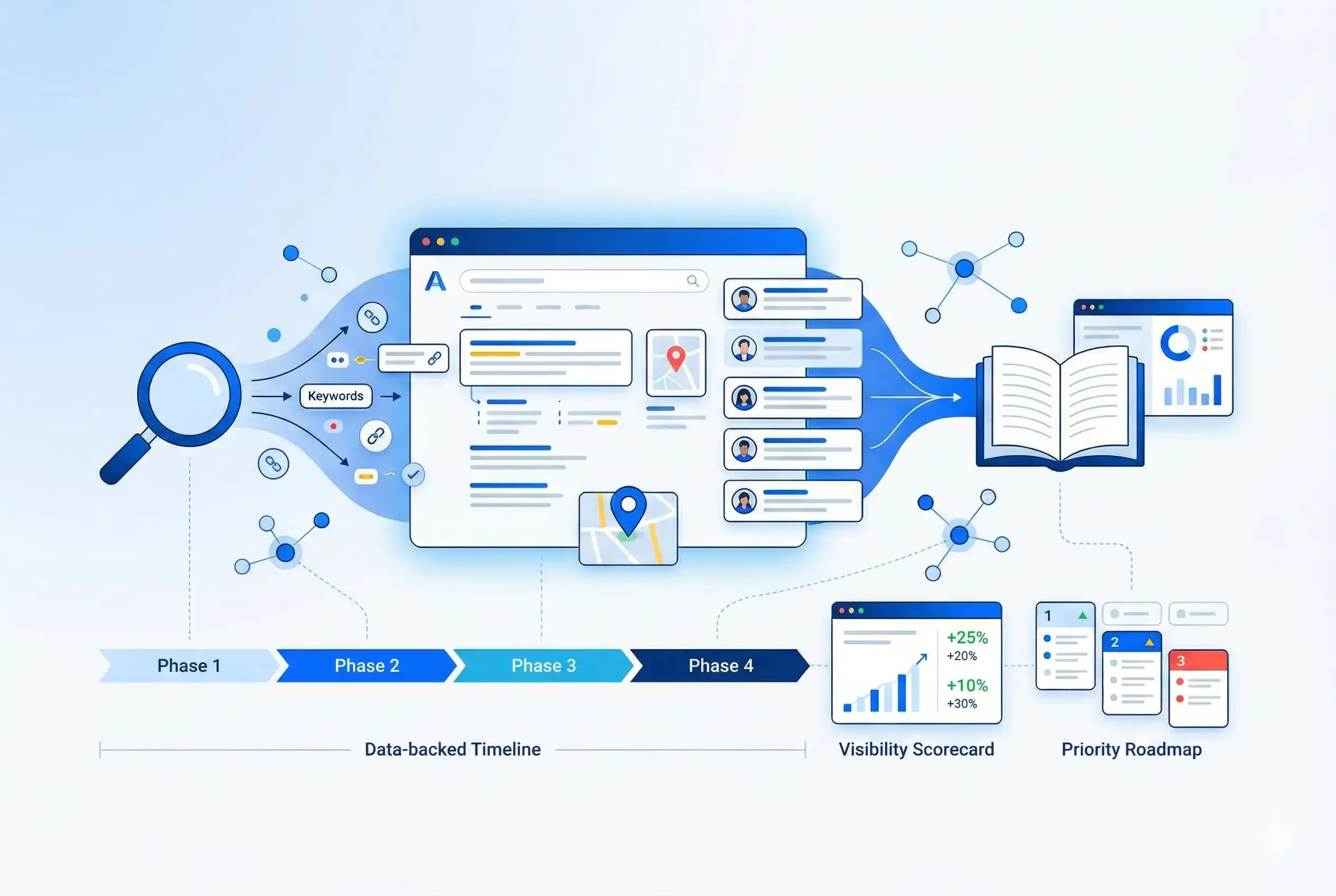
- The audit is delivered in 10 business days: a Visibility Scorecard, a Priority Roadmap, a live measurement dashboard, and an Execution Backlog.
- This site practices what it teaches: our own llms.txt, structured data, and AI-crawler-friendly robots.txt are live right now.
- 60%+ of Google searches end in zero clicks — visibility increasingly means being cited, not just ranked.
AI is rewriting how businesses get found. AI Overviews now appear on nearly half of all Google searches, and most of those answers cite sources that don't even rank in the traditional top 10. Meanwhile, ChatGPT, Perplexity, and Gemini are becoming search engines in their own right.
Our Search & AI Visibility Assessment gives you a clear, data-backed picture of where you stand across traditional SEO, local search, and AI-powered discovery, plus a prioritized roadmap to close the gaps. Delivered in 10 business days.
The Search Landscape Has Split
Traditional SEO still drives intent-based traffic. But a parallel discovery layer has emerged: AI-generated answers that synthesize, cite, and recommend without the user ever clicking a link. Most businesses are optimizing for one layer and invisible on the other.
~48%
of Google searches now show AI Overviews, up from 30% a year ago
Only 17%
of AI Overview citations come from pages ranking in the organic top 10
60%+
of all Google searches end in zero clicks (77% on mobile)
Three Surfaces. One Clear Picture.
We don't just check your Google rankings. We assess your visibility across every surface where customers discover businesses today.
Traditional SEO Health
How well your site performs in organic search results.
- • Technical foundation: crawlability, mobile-first readiness, Core Web Vitals
- • Keyword positioning and content quality
- • Backlink profile health and authority signals
- • Indexation coverage and sitemap hygiene
Local Visibility
How you show up when people search near you.
- • Google Business Profile completeness and optimization
- • NAP (Name, Address, Phone) consistency across directories
- • Review volume, quality, and response patterns
- • Local Pack ranking and "near me" query performance
AI Citability (GEO)
Whether AI systems mention, cite, or recommend your business.
- • Citation presence in ChatGPT, Perplexity, Gemini, and Google AI Overviews
- • Structured data and schema markup readiness
- • Content extractability for AI ingestion
- • E-E-A-T signals (Experience, Expertise, Authority, Trust)
- • LLMS.txt and AI crawler accessibility
What You Get
Everything you need to make decisions, not just a report that sits in a drawer.
Visibility Scorecard
- • A single-page visual score across all three dimensions (SEO, Local, GEO)
- • Overall composite score (0-100) with dimension breakdowns
- • Benchmarked against competitors in your space
- • Designed to be shared with your leadership team or board
Priority Roadmap
- • Ranked action backlog: what to fix first, expected impact, effort level
- • Organized into quick wins (Week 1-2), medium-term (Month 1-3), and strategic (Month 3-6)
- • Each item tagged by dimension (SEO / Local / GEO) and effort (Low / Medium / High)
- • Actionable by any agency, in-house team, or our implementation sprints
Live Measurement Dashboard
- • Google Looker Studio dashboard connected to your Search Console and GA4
- • Tracks the KPIs that actually matter: clicks, impressions, CTR by query group, AI citation patterns
- • You keep this dashboard after the engagement. It's yours.
- • Baseline snapshot so you can measure lift from any action you take
Execution Backlog
- • Specific, ticketed action items ready to assign
- • Each ticket includes: what to do, why it matters, how to validate it worked
- • Organized into implementation sprints (Foundation, Local, GEO)
- • Exportable to your project management tool (Notion, Asana, ClickUp, etc.)
Our 10-Day Process
Days 1-2 · Phase 1
Setup & Access
- • You share Search Console, GA4, and Google Business Profile access
- • You provide your priority queries (10-20 topics your customers search for) and top 3-5 competitors
- • We configure the diagnostic tooling stack
Days 3-5 · Phase 2
Technical & SEO Diagnostic
- • Full technical crawl (indexability, mobile-first, CWV, broken links, redirect chains)
- • Keyword positioning analysis against your priority queries
- • Backlink profile and authority assessment
- • Content quality audit against current SEO best practices
Days 6-8 · Phase 3
Local & AI Visibility Mapping
- • Google Business Profile audit and local ranking analysis
- • NAP consistency check across directories and aggregators
- • AI citation scan: we query ChatGPT, Perplexity, Gemini, and Google AI Overviews with your priority queries and document where (and whether) you appear
- • Structured data and schema markup review
- • Competitor comparison across all three surfaces
Days 9-10 · Phase 4
Analysis, Scoring & Debrief
- • We compile findings into your Visibility Scorecard and Priority Roadmap
- • Dashboard goes live with your baseline data
- • 60-minute strategic debrief call with findings, recommendations, and next steps
- • Execution Backlog delivered for immediate action
From Assessment to Action
The assessment tells you what's broken and what to prioritize. The implementation sprints fix it. Each sprint is a focused, time-boxed engagement with clear deliverables. You can run them sequentially or in parallel depending on your priorities and budget.
Sprint 1: Foundation
4 weeksThe technical floor. Nothing else works if search engines can't crawl, index, or render your site properly.
- • Crawlability and indexation fixes (robots.txt, sitemaps, broken links, redirect chains)
- • Mobile-first parity and Core Web Vitals optimization
- • Structured data implementation (schema.org markup relevant to your business type)
- • Measurement infrastructure: Search Console verified, GA4 key events configured, baseline reporting live
Investment: $5,000 - $10,000 (fixed scope, complexity-dependent)
Who it's for: Every business. This is prerequisite work.
Sprint 2: Local Authority
4 weeksYour presence in Maps, Local Pack, and local search results. Critical for any business with a physical location or service area.
- • Google Business Profile optimization (completeness, categories, attributes, photos, post cadence)
- • NAP consistency audit and cleanup across 30+ directories and aggregators
- • Review acquisition workflow: automated review request sequences, response templates, escalation process
- • Location-specific landing pages created or optimized
- • Local citation building and third-party corroboration (feeds AI entity validation)
Investment: $4,000 - $8,000 (fixed scope)
Who it's for: Businesses with physical locations, service areas, or local customer bases.
Sprint 3: GEO & Content
8 weeksWhether AI systems can find, understand, extract, and cite your content. This is where most businesses are completely blind.
- • Content restructuring for AI citability: answer-first architecture, question-based headings, FAQ schemas
- • Credibility signal injection: citations, statistics, expert quotations, author expertise markers (E-E-A-T)
- • LLMS.txt deployment and AI crawler accessibility configuration
- • Entity-rich content creation that feeds AI knowledge graphs
- • AI citation monitoring setup across ChatGPT, Perplexity, Gemini, and Google AI Overviews
- • Monthly AI visibility reporting during the sprint
Investment: $5,000 - $12,000/month (8-week engagement)
Who it's for: Businesses that want to be recommended by AI, not just ranked by Google.
Sprint 4: Ongoing Governance
MonthlyContinuous optimization after the initial sprints. A fractional marketing brain on retainer.
- • Advisory (~1 day/week): Strategic direction, AI visibility monitoring, monthly reporting, vendor/agency oversight. $4,000 - $7,000/month
- • Hands-on Execution (~2-3 days/week): Everything in Advisory plus direct management of content pipelines, technical SEO maintenance, GEO optimization cycles, and quarterly roadmap refresh. $8,000 - $15,000/month
Who it's for: Businesses that want sustained growth without hiring a full-time marketing leader.
Powered by Best-in-Class Tools
We select, integrate, and govern the right tools for your stack. You don't need to buy or learn any of these yourself.
Peec.ai
GEO Monitoring
Track how your brand appears in AI-generated answers
Trakkr
AI Search Ranking
Monitor visibility across generative search engines
Screaming Frog
Technical SEO
Deep crawl diagnostics for site architecture
Google Search Console
Search Analytics
The source of truth for organic search performance
Google Looker Studio
Reporting
Live dashboards pulling from your real data
n8n
Automation
Workflow automation for content pipelines and monitoring
Exceptional Value, Clear Pricing
AIgist24 Search & AI Visibility Assessment
$4,999
Complete 10-day assessment across SEO, Local, and AI visibility
- Visibility Scorecard with composite score (0-100)
- Priority Roadmap with ranked action backlog
- Live Looker Studio dashboard (yours to keep)
- Execution Backlog with ticketed action items
- 60-minute strategic debrief with senior consultant
- Competitor benchmarking (up to 5 competitors)
- No hidden costs. Fixed scope. Fixed price.
Typical SEO Agency Audit
$10K - $30K+
4-8 week engagements, SEO only
- Traditional SEO audit only (no AI visibility)
- Generic recommendations, limited actionability
- No live dashboard or ongoing measurement
- Additional costs for implementation
- No GEO or AI citation analysis
- Results delivered in static PDF reports
Frequently Asked Questions
AI visibility, also known as GEO (generative engine optimization) or AEO (answer engine optimization), means being found, mentioned, and cited by AI assistants like ChatGPT, Perplexity, Claude, and Google AI Overviews when people ask questions in your space. It's a parallel discovery layer alongside traditional search rankings, built on structured, extractable, trustworthy content that AI systems can confidently synthesize and cite.
AI visibility complements traditional SEO rather than replacing it; SEO earns you a ranking position a human clicks on, while AI visibility earns you a citation inside a synthesized answer a user never clicks through to reach. The two overlap heavily on technical foundations, crawlability, structured data, authority, but AI visibility adds entity consistency and answer-shaped content structure that ranking alone doesn't guarantee.
Most AI assistants use search-augmented answering: they query an underlying search index (often Bing, for ChatGPT), then select sources based on extractable structure, topical authority, freshness, and how clearly a page answers the specific question asked. Pages with clean headings, schema markup, and direct answer-first content get cited far more often than pages that bury the answer in marketing copy.
Yes, unquestionably. AI answer engines are built on top of search indices, so a page that's poorly indexed or invisible to traditional search is equally invisible to AI. Bing's index in particular underpins a large share of ChatGPT's web-search citations, which means the technical SEO fundamentals, crawlability, indexation, site speed, remain prerequisite work, not a separate track from AI visibility.
The audit covers crawlability by AI bots (robots.txt, llms.txt, and rendering checks), your structured data and schema markup coverage, whether your existing content is shaped to be directly extractable and answerable, entity consistency across the web, and a baseline citation scan across ChatGPT, Perplexity, Gemini, and Google AI Overviews for your priority queries.
llms.txt is a plain-text file at your site's root that gives AI crawlers a structured summary of your site and its key pages, similar in spirit to a sitemap but written for language models rather than search bots. Adoption is still early and no major AI vendor has confirmed it materially changes citation behavior yet, but it's low-cost and we ship one on our own site.
Learn more →Technical fixes, crawlability, structured data, and llms.txt deployment, can show up in AI citation checks within a few weeks of going live. Authority-driven gains, ranking higher, being cited more consistently across a range of queries, typically take 2-4 months to build, similar to traditional SEO timelines, since AI systems weight many of the same trust and authority signals search engines do.
No one can honestly guarantee citation by any specific AI assistant; the underlying models and their source-selection logic change frequently and aren't under any vendor's or agency's control. What we do commit to is making your site maximally citable, technically crawlable, well-structured, entity-consistent, authoritative, and to track your actual citation rate over time so you can see real movement, not promises.
We track AI-referrer traffic in your analytics (visits arriving from chatgpt.com, perplexity.ai, and similar), run scripted citation checks against your priority queries across ChatGPT, Perplexity, Gemini, and Google AI Overviews, and calculate a share-of-voice score against your named competitors. You get a live dashboard, not a one-time PDF snapshot, so you can watch the trend, not just a point-in-time score.
Both paths are usually part of the plan. Existing content often just needs answer-first restructuring, clearer headings, direct answers up top, supporting schema, to become far more citable without a full rewrite. Where genuine topic gaps exist, we recommend targeted new pillar content; the Priority Roadmap tells you exactly which of your pages need which treatment.
Structured data (schema.org markup) is machine-readable metadata embedded in your pages that explicitly tells search engines and AI crawlers what your content is, a service, an FAQ, an article, an organization, rather than making them infer it. For AI visibility specifically, Service, FAQPage, and Organization schema types matter most, since they map directly to the kinds of questions people ask AI assistants.
Yes, and niche businesses often see it work faster than large, generalist competitors. AI assistants reward specific, authoritative answers to specific questions, and a focused niche player with genuinely deep expertise on a topic can out-cite a much larger competitor that only covers the topic superficially. Long-tail authority is, if anything, an advantage in AI-driven discovery.
Yes, the two engagements are complementary, not competing. We typically own the AI-visibility-specific work, structured data, GEO content restructuring, citation monitoring, while your existing SEO agency continues owning rankings, keyword strategy, and link building. We coordinate directly with your agency during the assessment so nothing is duplicated or working at cross purposes.
For a marketing site whose goal is to be found and chosen by prospective customers, blocking AI crawlers is almost always the wrong trade-off, it protects content nobody was going to pay for anyway, at the cost of being invisible in a rapidly growing discovery channel. Our own site deliberately allows every major AI crawler in robots.txt for exactly this reason.
Learn more →Start with the Visibility Audit: 10 business days, a Visibility Scorecard, a Priority Roadmap, a live measurement dashboard, and an Execution Backlog you can act on immediately, whether with us, your existing agency, or in-house. Use the booking button on this page to schedule a discovery call and we'll take it from there.
Last updated July 10, 2026
Your Customers Are Already Asking AI. Make Sure It Knows You.
In 10 business days, you'll know exactly where you stand across Google, AI Overviews, ChatGPT, and Perplexity, and exactly what to do about it.